Monday, 29 October 2012

Skyfall

The following review contains spoilers...


The Bond franchise's last big milestone, its fortieth anniversary, was tarnished with the painfully disappointing Die Another Day. The combination of face-morphing technology, an invisible car, dire one-liners and a Madonna cameo signified an all-time low for Britain's most iconic spy.


Thankfully, MGM have taken no chances with Bond's fiftieth anniversary.

On paper, Skyfall is the most promising Bond film to date: an Oscar-winning director (Sam Mendes), an Oscar-winning villain (Javier Bardem), the return of two of Casino Royale's scriptwriters (Neal Purvis, Robert Wade) and the best Bond song since Goldeneye (thank you Adele).

So does Skyfall live up to the expectation? 

Well, as the critics, the box office and your Facebook news feed will have confirmed by now: yes, Skyfall is a superior Bond outing. It deserves to be placed alongside the usual Bond favourites, which typically list as Casino Royale, Goldeneye, Goldfinger and Dr No.

Mendes' influence as an Academy-friendly director is abundant throughout, evoking powerful performances from his leads and capturing some stunning shots courtesy of cinematographer Roger Deakin (another Oscar-winner). Hands-down, this is the best-looking Bond film of the series. Mendes also proves he can handle elaborate action scenes, with an adrenaline-pumping pre-credits scene across rooftops and trains (although, nothing comes close to Casino Royale's parkour). It is refreshing to see the franchise finally attracting such a high calibre of film-makers and this looks set to continue, with Mendes already voicing his interest to return for Bond 24.

Plot-wise, Skyfall offers something new. Ultimately, this is a story of revenge. M betrayed her former top spy, Bardem's Raoul Silva, and now he is looking to destroy her reputation and shoot her dead. Bond, ever the loyalist, decides to protect her. The simplicity is refreshing. Instead of saving the world, Bond is saving his boss. Instead of ending the film by infiltrating an exotic secret lair, the climatic battle occurs on the moors of Scotland. This comparatively low-key approach allows us to focus on the characters and so the personal stakes are higher than ever. It makes for compelling viewing.

Daniel Craig is well into his stride as Bond and wears the role confidently, handling the action, the flirting and the inner torment with apparent ease. It is testament to Craig's screen presence that he is not overshadowed by Bardem's villain, who is given the best dialogue and lots of great material to sink his (removable) teeth into. Like all good villains, Silva can make the audience laugh, jeer and cringe in discomfort, whilst often winning us over to his cause. Arguably, Bardem's Silva is the most Joker-like performance since The Dark Knight.

Sadly, the Bond girls are less captivating. Naomie Harris' Eve is surplus to requirements, whilst Berenice Marlohe's haunted Severine is woefully short-lived. None of that matters though because Judi Dench's M is the real Bond girl here. Finally, after six previous film appearances, Dench's M is upgraded to a leading role and not wasted in fleeting cameos and exposition. As with The Dark Knight Rises which happily sidelined its hero, Skyfall is equally happy to put Bond aside for numerous scenes. In many ways, this is M's story. She is literally on trial here. The vendetta is against her. All of this is good news for audiences because it means we get to see more of Dench, surpassing Bernard Lee as the definitive M.

But aside from strong performances and competent execution, there are times when Skyfall seriously drops the ball. Sadly, Bond appears to be edging back towards the fantastical elements of the franchise that Casino Royale and Quantum of Solace tried so desperately to eradicate. We therefore get the return of Q and his gadgets. Admittedly, these are not too flamboyant (and the dialogue highlights this beautifully) but it is a regressive step. There is a very real danger that one or two films down the line might see Bond once again driving underwater cars or wielding a laser-firing Rolex. Another example of suspended realism is the climatic assault on Bond's booby-trapped childhood home. The final reel plays out like the Bond equivalent of Home Alone.

There are a handful of other problems: there are plot-holes (why did Bond let them kill Severine when he had three helicopters on standby?) and naff lines ("Welcome to Scotland!") and a muddled credit sequence (stags, targets, Chinese dragons... pick a theme and stick to it!). Also, the Aston Martin reveal may have earned a cheer from the crowd but ultimately it was a moment of laugh-out-loud daftness in a supposedly gritty, re-imagined Bond universe.

And as for those CGI komodo dragons... this isn't Lake Placid.

But whatever, this is a birthday celebration and much can be forgiven. The most important thing is that Bond is still looking good at 50. The studio have done plenty of legacy-building in Skyfall, reintroducing Q and Moneypenny and another M and so there is a rich palette on offer for future film-makers when making the next few Bond films.

Because, have no doubt, Bond will be going for another 50 years. Skyfall is not the limit.

★★★★

Saturday, 20 October 2012

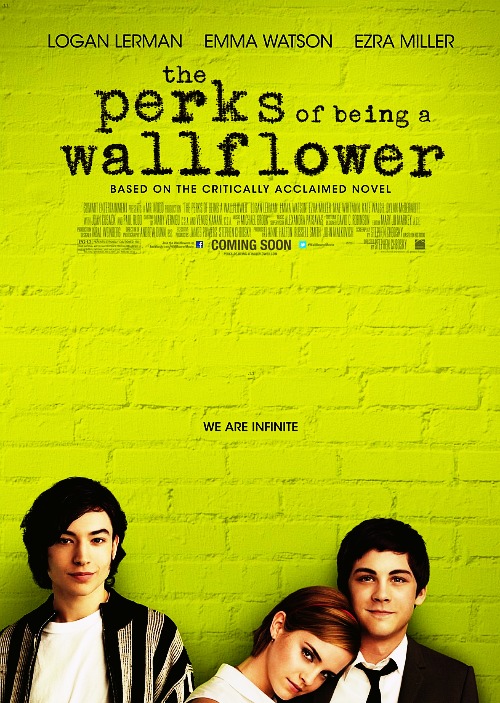
The Perks of Being a Wallflower

The Perks of Being a Wallflower is a teenage coming-of-age drama based on director Stephen Chbosky's critically-acclaimed novel and driven by three strong performances.

The talented central trio - Logan Lerman, Emma Watson and Ezra Miller - each successfully reinvent themselves and shed the roles for which they were previously better known. 

Lerman excels as the understated narrator of the film, Charlie, putting aside his action persona seen in Percy Jackson and The Three Musketeers, for an altogether more subtle and emotive performance. Watson is captivating as free spirit Sam, finally casting off the shackles of squeaky-clean Hermione Granger and making the most of the edgier, grown-up material. Lost in Translation made audiences fall in love with Scarlett Johansson and Wallflower will do the same for Emma Watson. Meanwhile, Miller is barely recognisable as the creepy actor who brought the psychopathic Kevin Katchadourian to life. Here, Miller plays the warm, charismatic and hilarious Patrick, offering both comic relief but also a big dosage of heart. 

All three deserve recognition for their performances.

The film successfully honours its source material, which is not surprising considering the producers hired author Stephen Chbosky himself to adapt his own novel for the big screen. Chbosky has therefore delivered a faithful script, packed with light-hearted observations of high-school but also addressing relevant issues faced by teenagers: falling in love, low self-esteem, homophobia and the rest. Despite the presence of the usual high-school motifs - SATs, prom, scraps in the canteen - Wallflower never feels anything less than original.

Wallflower is not afraid to go dark. The story of Sam's first kiss and the incident from Charlie's childhood are particularly chilling. But the feel-good moments are never far away: Secret Santa, Rocky Horror, Paul Rudd's fatherly teacher, a superb graduation prank aimed at Tom Savini's woodshop teacher and the stand-out use of David Bowie's Heroes. Indeed, some of the best scenes just feature the trio sitting around with their friends enjoying each other's company. As an audience member, you will feel part of the gang too.

It is no coincidence that Lost in Translation was mentioned earlier in this review. Wallflower shares much with Sofia Coppola's bittersweet surprise hit. Both are unlikely love stories with stunning soundtracks and a perfect balance of comedy and soul-searching. Equally, both manage to turn ordinary locations (hotel rooms, bedrooms, bars, house parties, tunnels) into glowing, magical places thanks to a lovingly-crafted mix of set design, lighting and direction. It is bizarre to think that Chbosky has never directed a film until now. He has a long career ahead of him.

And, like Lost in Translation, Wallflower deserves unexpected hype and Award Season attention. Above all else, it deserves to be seen, loved and remembered.

★★★★★

Sunday, 30 September 2012

Looper

Director reunites with Joseph Gordon-Levitt to deliver Looper, a very different type of film to their previous collaboration, the cult indie Brick. 

Or is it? 

Because Looper, despite promoted as yet another sci-fi action flick, shares much with the indie mentality of believable characters, a constantly-developing story and the marrying of great actors with great material. Johnson's script is full of great scenes, whether it be the stand-out diner confrontation between Joe Simmons (Joseph Gordon-Levitt) and his older self (Bruce Willis) or the emotional revelation from a troubled mother (Emily Blunt) about her 'special' child. 

Johnson also manages to cram in enough original and clever ideas to ensure Looper remains a science-fiction film, as opposed to being an excuse for action like recent offerings (In Time, Prometheus, John Carter, Total Recall, Cowboys & Aliens and the rest). Not that the action is lacking. There is plenty to keep mainstream audiences munching on their popcorn, as Willis fires dual machines guns and henchmen ride flying motorbikes. But genre-wise, Looper is closer in-line with Duncan Jones' Source Code and happily addresses the sci-fi elements of time-trickery. For example, a particularly innovative scene features a character rapidly losing their limbs because his past self is being brutally maimed by a torturer. Very clever, very haunting.

Johnson is equally capable of holding the camera, as well as the pen, and he assembles his film with the skill that you would expect from a previous winner of the Sundance Jury Prize for Originality of Vision. Like the recent Dredd, Johnson creates a believable futuristic world with a relatively low budget. The exposition-heavy opening is also expertly-crafted. Using a combination of voice-overs, montages and narrative flow, Johnson manages to establish an alternative future, introduce characters and teach the audience about 'closing the loop' and telepathy without ever sounding like a lecture.

Looper's greatest strength is its story, which will not be spoiled in this review. Suffice it to say, the twists and turns will keep the audience hooked. It is genuinely hard to guess where the story is going (a rare find in cinema today), even more so when the action relocates to a corn-farm for the second half of the film. 

A final mention must be given to the cast. Joseph Gordon-Levitt further cements his leading-man status, now adding action hero to his CV. He also perfects the trademark smirk of a young Bruce Willis. Meanwhile, Willis himself proves that he can still dispatch a room full of henchmen but equally reminds audiences that, unlike the rest of the Expendables, he can actually act. But most impressive is child actor, Pierce Gagnon, who holds his own against all of the grown-ups and steals a fair few scenes himself.

Looper is a refreshing genre-bending marvel: part-blockbuster, part-science-fiction, part indie. It looks set to win over the Friday night crowd and the film critics alike, whilst Johnson edges towards becoming an established name in Hollywood. 

Here's hoping we don't have to wait another four years for the next Rian Johnson film.

★★★★★

Sunday, 9 September 2012

Dredd

Dredd is an unusual approach to a comic book adaptation: low-budget, simple plot, small cast, few big names and it's only 95 minutes long. In many ways, it feels like an extended pilot for a TV show. But, based on this evidence, there is plenty of potential for franchise development.

It is not surprising that a Judge Dredd reboot has been approached with caution. 


After all, the eponymous futuristic law enforcer from the 2000 AD comic strip has a relatively small fan base compared to the likes of Spider-Man, Batman and Superman. Plus, the last time Dredd was brought to the big screen was in Danny Cannon's 1995 flop, Judge Dredd, starring Sylvester Stallone in the titular role. This earlier attempt floundered at the box office, offended the fans (Dredd never takes his helmet off in the comics), garnered disapproval from Dredd creator John Wagner and earned Stallone a Razzie for Worst Actor, so naturally a relaunch was only going to be green-lit provided it would be a low-risk affair.

As such, director Pete Travis and writer Alex Garland obligingly keep things simple. The plot is straightforward: Dredd (Karl Urban) is partnered with a rookie (Olivia Thirlby) on a routine triple-homicide investigation at Peach Trees, an apartment block under the rule of psychotic drug-queen Ma-Ma (Lena Headey). When Ma-Ma's lieutenant (The Wire's Wood Harris) is arrested by Dredd, Ma-Ma locks down the block and the Judges have no choice but to fight their way upwards through multiple floors of henchmen.

Audiences are therefore presented with a low-stakes mission, limited to one location and a handful of characters. The lack of scale is a smart move and offers cinema-goers a gentle introduction to the Dredd mythology. We get a glimpse of dystopic Mega City One, a brief mention of mutants and an element of the supernatural in the form of Thirlby's telepathic rookie, all of which play a bigger part in the comics and have presumably been reserved for a better-funded sequel.

Most crucially, this focussed approach allows newcomers the opportunity to discover Dredd himself, rather than getting distracted by sub-plots and the wider mythology. Urban's Dredd is thankfully faithful to the 2000 AD comics: a grim, uncompromising, incorruptible force, with no time for humour or wisecracks or mercy. And Dredd purists will be relieved to hear that Dredd keeps his helmet firmly on, resulting in some admirable chin-acting courtesy of Urban.

Travis delivers as director, realising that if a film is low on plot then it should be big on style. Travis keeps the action brutal and the tone dark but can equally deliver inventive camera-trickery when necessary, such as when Thirlby's psychic invades a villain's head for information. The frequent drug-induced sequences are particularly captivating. The aptly-named drug, Slo-Mo, allows for some beautifully balletic sequences as glass shatters, bullets fly and blood splatters, all in slow-motion, with saturated colours and added special effects. These sequences were perfected by VFX supervisor Jon Thum and Alex Garland in post-production and justify paying for those 3-D glasses.

Various critics have noted that Dredd shares its plot with that of The Raid, the Indonesian martial arts flick that wowed audiences earlier this year. Many have argued that Dredd suffers from this comparison due to the frenetic - and admittedly better - action sequences delivered by The Raid. 

But whilst The Raid swiftly negotiated fight after fight, Dredd is more evenly-paced and allows room for the characters to shine. The Raid was populated with two-dimensional characters, headlined by a vanilla hero. Whereas, Dredd offers plenty of engaging characters, such as Thirlby's psychic and Headey's vicious gang leader, with Dredd himself already established as an enigmatic anti-hero. And whilst The Raid relied on Pentak Silat martial arts to excite audiences, Dredd has the advantage of being set in the future which provides plenty of equally cool gimmicks: Dredd's multi-tasking gun (the Lawgiver), his formidable bike (the Lawmaster) and his ever-iconic helmet.

If there is a criticism to be levelled at Dredd, then it would be the lack of scope. But then, as said earlier, this narrow look at the Dredd world was a necessary approach for the relaunch. Predictably, a sequel would heighten the stakes, add some complexity to the story and delve into the wider communities of both Mega-City and the ranks of law enforcement. And hopefully, based on this teaser, cinema-goers will demand a larger-scale Dredd adventure.

But you can be the judge of that.

★★★

Friday, 31 August 2012

Expendables 2

Let's get one thing straight: Expendables 2 is not a good film. It offers two hours of terrible dialogue, wooden acting and forced cameos. But it's a hell of a lot of fun and the best bad film that you will see all year.


Thankfully, the sequel fixes the mistakes of its disappointing predecessor, which made the crucial error of taking itself too seriously. But Sylvester Stallone has wisely vacated the director's chair for Simon West, director of the ever-enjoyable Con Air, who knows exactly how to approach this type of film. Namely, make the most of the famous faces and low expectations and just have some fun! 


And West succeeds. In fact, the first ten minutes of Expendables 2 offers more cheese, more silliness and more ridiculous action than was found in the entirety of its predecessor. Audiences can leave their brains at the door and enjoy Jet Li dispatching henchmen with cooking utensils, Jason Statham disguised as a kick-ass monk, Sly facing off against Jean-Claude Van Damme and Arnold Schwarzenegger ripping the door off a Smart Car. West knows how to deliver action, as do his veteran cast.

Unfortunately (or fortunately depending on your sense of humour), the cast cannot deliver dialogue, nor can Stallone write it. The dialogue is comprised of tough guy talk ('Track 'em, find 'em, kill 'em!'), bad puns ('Rest in pieces!'), worse puns ('I now pronounce you man... and knife!') catchphrases ('Yippee ki yay!'), laziness ('You have an ego the size of a dinosaur'), nonsense ('You've been back enough, I'll be back!'), racism (the Chinese woman's favourite meal happens to be crispy aromatic duck) and lifeless banter ('If you need me, call me, or I'll kill you').

The acting is as bad as the dialogue but you knew that already. The only cast member in danger of doing any acting is Liam Hemsworth but they kill him off nice and early to keep the plot moving. On the other side of the acting spectrum is Yu Nan, as newly-appointed technical expert Maggie Chan, who is just plain terrible. Presumably, she was cast to make everyone else look good and anyone who can make Dolph Lundgren look like Marlon Brando is a very rare find indeed.

Naturally, Expendable 2's biggest draw is its wish-fulfilment casting. Schwarzenegger and Bruce Willis are both back with thankfully more screen time and Jean-Claude Van Damme is a welcome addition to the cast as the new villain. He can still pull off those flying kicks. Best of all, Chuck Norris pops up in the most insanely crowd-pleasing cameo ever seen on the big screen. Norris rocks up in a baseball cap, dispatches an army single-handedly, tells an actual Chuck Norris joke (!) and then saunters off into the sunset.

Predictably, Sly isn't done yet. Expendables 3 is due to start filming later this year. Sly has been talking big about rounding off the trilogy and shifting the genre to keep audiences engaged, bless him. But over-thinking it would be a mistake. As ever, the credits will be the biggest draw. And with Sly already approaching Steven Seagal, Wesley Snipes, Nicholas Cage, Harrison Ford, Clint Eastwood and Jean-Claude Van Damme (who would play the twin brother of his character in this film!), the box office looks set to be bigger than ever.

In the meantime, Expendables 2 offers enough adrenaline-pumping action and laughable lines to keep you sufficiently entertained until their next outing.

And just to reiterate: Expendables 2 is a bad film. But that doesn't stop it being bad-ass.

★★★

Brave

Only an animation studio with Pixar's reputation could produce a film like Brave and leave audiences feeling slightly disappointed. Whilst the standard of the animation, voice-acting and writing is as high as ever, Brave lacks that one crucial aspect that we have come to expect from a Pixar outing: originality.


Arguably, from a Pixar perspective, the world's greatest animation studio were doing something very original indeed. After all, the past two Pixar films have been sequels and so a host of new characters is a welcome arrival. Brave breaks a lot of new territory never before seen in Pixar's feature-length filmography: a female protagonist, a princess protagonist, a British setting, the use of magic and this is the first Pixar film to be set in the past. In short, this is Pixar's attempt at a fairy tale and they put their gritty, well-researched take on the usual cuddlier fair. 


This is also the first Pixar film to focus on a mother-daughter relationship and therefore acts as a thematic companion piece to the father-son relationship in Finding Nemo. The portrayal of Princess Merida's troublesome relationship with her mother is so smartly-written that even the youngsters in the audience might side with the mother. No doubt, the involvement of Pixar's first female director, Brenda Chapman, was the key to nailing this relationship.

However, whilst all of this might be new territory for Pixar, it is old news for the average cinema-goer.

Audiences have seen plenty of rebellious Princess stories over the years: The Little Mermaid, Aladdin, Pocahontas, Mulan, The Princess and the Frog, Tangled and those are just the Disney examples. Brave dutifully follows the formula of such films and therefore feels very familiar. It arrives at a predictably tidy resolution and offers few surprises along the way (with the exception of one big metamorphosis twist which, fair play, they managed to hide from the multiple trailers). Who would have thought a Pixar film would ever be labelled formulaic?

Let's be clear. Brave is still the best animation you will see on the big screen in 2012: lovingly-crafted, beautifully-scored by Scottish composer Patrick Doyle and there are plenty of laughs to be had from the bickering Scottish clans. 

But it lacks the courage to challenge the Princess formula and so Brave fails to live up to its title.

★★★★

Tuesday, 28 August 2012

Ted

After a decade of Family Guy and American Dad, Seth McFarlane finally makes his directorial debut on the big screen. However, as with any episode of Family Guy, the reality is a mixed bag of gags, with equal measures of hits and misses.

This is a shame because, on paper, Ted should be an instant hit.

The concept driving the film is a truly original idea: young John's wish is granted and his teddy bear comes to life. But then John grows up (Mark Wahlberg) and he still has his walking, talking teddy bear as a best friend. McFarlane's writing explores the consequences of this scenario, both the dramatic and the comedic: what affect would this have on John's relationship with Lori (Mila Kunis)? How can John act his age with his teddy bear in tow? What would happen when the teddy bear reaches the legal drinking age? Unfortunately, the drama is often handled better than the comedy.


Much of the comedy is hoped to be generated by Ted himself. Sticking with the Family Guy formula, McFarlane aims to produce laughs by having a human partnered with a sidekick that shouldn't do adult things... but does. We have seen this with Family Guy's Brian and Stewie: a dog and a baby that drink, smoke, swear, fight, crack wise and have sex. Ted follows suit. Admittedly, seeing a teddy bear raise its middle-finger, say the F-word and smoke a bong in the trailer was hilarious. But with a feature length film, the joke soon gets old.

The comedy is stop-start. Some jokes land but many fall flat. 

Highlights include Ted's failed attempts to get fired, Mila Kunis picking up poo, McFarlane's trademark pop culture references, Ted squaring off with a chicken and Mark Wahlberg in general, who needs to be given more comedy roles. We also get Sam Jones (the original Flash Gordon) playing himself at a house party, necking shots, snorting cocaine, tripping out, fighting a disgruntled Chinese neighbour ("Miiing!") and overall just being an ageing Hollywood bad-ass.

But the lowlights include Patrick Stewart's opening voiceover which fails to get the film started, a wasted Joel McHale as Mila Kunis' sleazy boss and crude, loud moments such as when John farts in a restaurant. Chaotic, see-what-sticks comedy is fine in a long-running TV show like Family Guy. But with a film, when you only get 110 minutes, you need to have all killer and less filler.

That said, chaotic comedy can work on the bigscreen, as seen with Anchorman and 21 Jump Street (which retains the crown of Comedy of the Year), but only if the gag rate is high. However, McFarlane chooses to give equal weight to the dramatic scenes exploring John and Lori's turbulent relationship. This is not necessarily a bad thing because these scenes are well-written and well-acted. But it does put extra pressure on the comedy, which, as noted, does not always deliver.

Nevertheless, maybe this is being unfair. 

In many ways, Ted is the Avengers of comedy films: highly-anticipated and never going to please everyone. After all, this is Seth McFarlane's first feature film and it was never going to live up to the astronomically high standards demanded by Family Guy fans. As such, it is important to be clear: Ted is a superior comedy. It is certainly funnier than the tiresome rom-coms and formulaic Ben Stiller comedies that are churned out every year. It is just testament to McFarlane's reputation as a TV comedy don that we expected some more belly-laughs.

But McFarlane can walk away from this proudly. And based on the potential on offer here, both McFarlane and Ted deserve another outing on the big screen.

★★★